Table Of Content
An IP54 rating means they can withstand moderate dust exposure and water splashes from any direction. You don't need to worry about sweat or light rain, but you shouldn't submerge them. This is a fairly typical rating for noise-cancelling earphones, but consider alternatives like the IP68-rated JBL Reflect Aero ($149.99) if you plan to work out in the elements.
1: Factorial ANOVA 1- Balanced Designs, No Interactions
If you’ve been struggling to create visually pleasing designs, it could be that they’re lacking in this department. Thankfully, you don’t have to be an expert to apply this principle to your next project. Balance can also help draw the viewer’s attention towards specific elements in a design. When used correctly, you can create focal points in a composition that will guide the reader to the most important information at hand. With this type of balance, elements don’t have to be perfectly symmetrical, but they may end up that way naturally since everything radiates out from one place. Radial balance is when you distribute elements around a single point — usually the center of a composition.

Factorial ANOVA versus one-way ANOVAs
The text on the right is larger and darker overall, but the blue circular logo gives more weight to its general area. The circle even connects to the top-left corner of the grid through a single color. I hope this idea that the principles of gestalt lead to many of the design principles that guide us has become clearer as you’ve read through this series. The design principles we follow didn’t arise out of thin air; they emerged from the psychology of the way we perceive our visual environment.
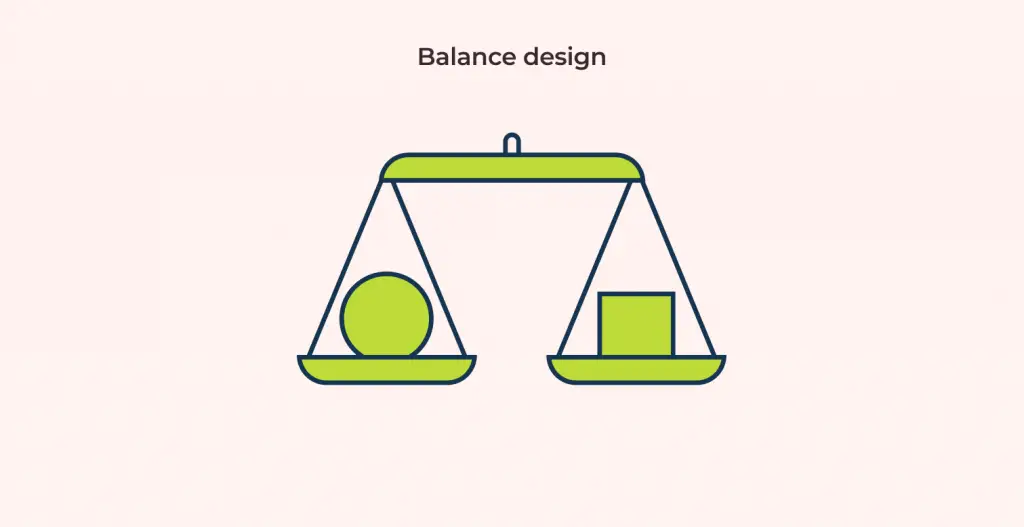
What is balance as a design principle?
My eye wants them to be the same and wants the center to be in between the “About” and “People” links. Asymmetry creates more complex relationships between elements, and so it tends to be more interesting than symmetry. Because it’s more interesting, asymmetry can be used to draw attention. Rotational symmetry (or radial symmetry) occurs when everything rotates around a common center. It can occur at any angle or frequency, as long as there’s a common center.
Why have I been blocked?
To make a design really stand out, designers might find it easier to use textures. But to do this without losing out on the overall balance they tend to have a large area of solid color or smooth texture. And they combine this with a small area, or areas, consisting of an interesting texture. This automatically creates a balanced effect despite the combination of textures in the other areas. Leveraging the power of balance in design, some designers intentionally create an off-balance design when they have to trigger certain emotions.
Whether it’s symmetrical, asymmetrical, radial, mosaic, discordant, or other ways of balancing, think about which way will work best for your design. For instance, you can have several small elements that balance out one large element. Or, you can have smaller elements positioned further away from the center of the composition. In either case, the elements are not the same size and not positioned evenly like with symmetrical balance.
Radial balance occurs when elements radiate from a common center. Rays of sunlight and ripples in a pond after a stone is tossed in are examples of radial balance. Maintaining a focal point (fulcrum) is easy because it’s always the center. The last major type of balance in design is the concept of off-balanced designs. Sometimes, the designer might not be sure that the different types of design balancing concepts would be of use to boost the impact of your piece of art.
Balanced By Design: Mornings In Venice with Girl Boss Ara Katz - The Chalkboard Mag
Balanced By Design: Mornings In Venice with Girl Boss Ara Katz.
Posted: Wed, 18 Nov 2015 08:00:00 GMT [source]
Or in other words, this will be the section that summarizes what the design is about. And the reason why this is often in big chunky text is to draw attention. When you get customers to take notice of your ad and instantly convey the gist of the ad, there are better chances of conversion. In the second change we have fixed our contrast issue, but the primary button now feels far too heavy compared to the secondary button. Visual weight is the perceived weight of an element in your design. It is a measure of how much an element stands out compared to those around it.
This can sometimes border on being uninteresting, but with the right designer, it can be eye-catching. Designing a business card poses this challenge because of the limited space, but this previous work from Penji shows balance can do wonders for small spaces, too. Another way to give balance to your designs is through the use of value. In this poster from Oral-B, the area of high value (the burger part) creates balance with the area of low value (the dental floss part).
Having balance doesn’t mean you can’t have contrast or a focal point. However, you should consider how to distribute and manipulate the other design elements to maintain proper visual balance. While asymmetrical balance merely shifts the perspective in an image, off-balanced designs create a feeling of unrest.
When these two opposites come together, the complex details will fall into balance with the plainness on the other side of the design. The elements perfectly balance each other out on both sides, with black on white and white on black. The design is appealing to the eye and feels rather calming and organized. So far we have discussed experimental designs with fixed factors, that is, the levels of the factors are fixed and constrained to some specific values. In some cases, the levels of the factors are selected at random from a larger population. In this case, the inference made on the significance of the factor can be extended to the whole population but the factor effects are treated as contributions to variance.
This kind of balance can only be incorporated in specific scenarios, and can be somewhat complicated to implement if the designer is not as experienced in creating such designs. The tree in the image starts out far from the centerline, but the canopy of the tree spans the entire top of the design. To balance that, the small house is placed close to the centerline, and near the bottom of the image. Moreover, as the framing of the shows the tree in the foreground, the house is designed to be viewed at a distance. Symmetrical balance in design is something we see a lot in nature.
You can draw a straight line through the middle of the design in any direction and the visual balance would be evenly distributed. This makes the composition appear stable and creates a more orderly look. With balance from eye direction the attention that higher visual weights get will be neutralized. This can be achieved by using light colors or smaller elements in the direction that is emphasised. In the above types of balance, designers can experiment with different combinations of visual weights. But there are times when there are too many elements in the design and each can be of different visual weights that cannot be easily segregated.
Centering is the easiest way to get a symmetrically balanced page. But be careful, as it can be difficult to create a centered design that doesn't look flat or boring. This is the most common type of balance that you will see in a design. If you draw a line vertically or horizontally, you should see that the visual weight is balanced.
It tones them down in a way that a bright white never could – the contrast between them is just too glaring. Here we go deep on all things spiritual awakening, cosmic consciousness, intuitive gifts, high vibrational living, and beyond. The podcast has since evolved into an awakening diary of sorts, and we are thrilled to have you tune in. Each of these specializations provides graduates with the skills necessary to pursue careers in these dynamic industries.




No comments:
Post a Comment